
Translator’s Preface
Åsa Linderborg’s interview with Andrev Walden was originally published in Swedish in Vi läser in April 2024, a few months after Walden’s debut novel Jävla karlar was awarded the 2023 August Prize.
As former colleagues at Aftonbladet – and as writers whose debut novels both draw deeply on childhood experience – Linderborg and Walden engage here in a thoughtful and candid exchange. I found the interview not only compelling as a reader, but also helpful to my translation process as I worked on the novel. Later, it occurred to me that others might enjoy reading this great piece too and I set about translating it. Now I’m sharing it here with you.
Vi läser is consistently one of the most thoughtful and engaging literary publications in Sweden, and I highly recommend it (right now, you can try it out for 3 months for just 3 kronor). The original interview in Swedish is available here.
The translation below appears with permission and is presented for non-commercial, informational use only. Please get in touch if you’re interested in republishing this elsewhere.
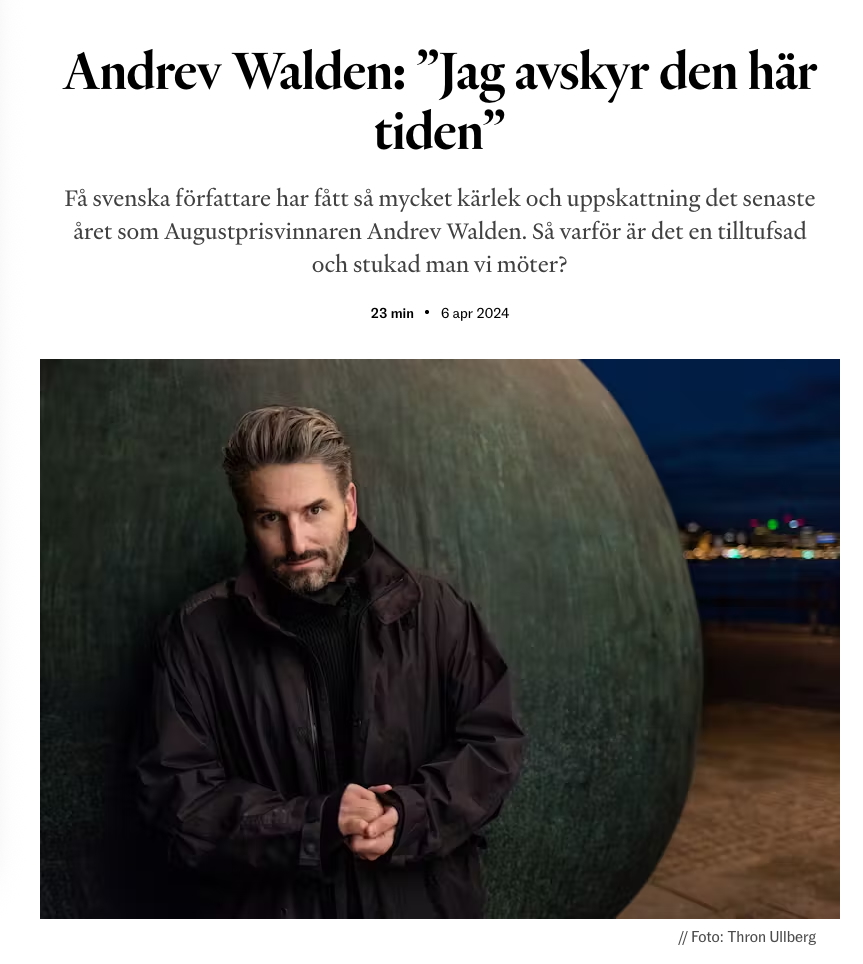
Andrev Walden: ‘I hate this age’
Few Swedish authors in recent years have garnered adulation and appreciation to the extent that August Prize winner Andrev Walden has. So why does the slightly flustered man we meet look like he’s been cut down to size?
Andrev Walden hates everything to do with technology – that’s the first thing he says when we meet for lunch at Pelikan, a fixture in Stockholm’s Södermalm neighbourhood since the nineteenth century. The minutes preceding his arrival have been spent searching for the recording app on my phone against a backdrop of the lunch service hum.
Andrev sits down, takes over scrolling through my phone and eventually tracks down the app.
‘My other half has this old fashioned belief that it’s my job as a man to deal with all that stuff, but when I’m faced with technology I’m like a wall. Impenetrable.’
This surprises me; I thought Andrev was a wizard in relation to all things new and technological, having been denied such things as a child. They didn’t even have a television.
‘The simple act of paying my bills has become utterly unbearable. I can’t deal with logging on to these payment services, my inbox and my online banking. These days you have to be an engineer to do your life admin.’
Andrev Walden was born in 1976. At 45, it began to dawn on him that he was going to age like all other men.
‘I feel alienated from the world and think things were better back in the day – I never thought that would happen to me. I hate this age. There’s almost nothing at all about this new lifestyle that I like.’
This is the very reason why Andrev Walden finds the prospect of being an author so attractive.
‘It’s a way of shutting yourself out of a society that you don’t feel at home in.’
It must be quite a feat to bolt the door when everyone wants a piece of you. I saw Andrev at the Gothenburg Book Fair in September 2023. There’s never any shortage of luminescent stars at the event, but around him and Bloody Awful in Different Ways there were four days of pleasant buzz and effervescence. Andrev was surrounded by a swarm of people of all ages and genders. The queues at his signings were never-ending, a fact not aided by the fact that Andrev exercises the greatest of care in signing his autograph, drawing mushrooms and other things that make the heart beat faster.
‘Mind you, a couple of autograph hunters were disappointed to be told by someone as I was signing their notebooks that I wasn’t Jens Lapidus. That was good for me. As you know, “Memento mori” is the Latin for “Don’t forget you’re not Jens Lapidus”.’
Andrev Walden is well known to Swedish readers as a columnist for broadsheet newspaper Dagens Nyheter, but before he wound up there he was an editor for the tabloid Aftonbladet. I remember him from back when Aftonbladet’s offices were at the old Globen arena. He would often be staring at his beachballing screen as it devoured his working hours. Just as often, I would see him twisting his hair while thinking up a clever headline or a witty caption – tasks at which he was a master.
Andrev still twists strands from his mop of black hair – now flecked with grey – that I suspect he inherited from his father, whom he long believed to be a Native American. Bloody Awful in Different Ways is about how Andrev’s mother gave him seven ‘fathers’ in the space of seven years – one after the other – while his biological father remained a stranger to him: a mysterious enigma around which fantasies and identity could be spun.
I’ve been just as floored by this bildungsroman as everyone else in Sweden. Bloody Awful in Different Ways is a stylistic and mature triumph about a child who grows up in circumstances that one could neither imagine nor fabricate.
‘I was writing another book that I liked a lot, but then things happened around me in my life which left me thinking a lot about death. That was when I realised I had to write this story first. I had to write the best book I had in me, because you never know when it’s too late.’
The book opens with Andrev, his siblings and his mother living together with ‘the Plant Magician’, a passive aggressive out-of-work hippie. After that, they end up with a careworn artist. The third is a junkie. And so on. Everyone lies. Everyone is out for themselves. Everyone exploits, wears down and in their own way abuses Andrev’s mother. ‘Jävla karlar’ (which is the title of the book in Sweden and translates literally as ‘bloody men’) is her refrain as she takes a drag on her cigarette in the kitchen of her best friend, Little Cloud. All the characters in the book are referred to using nicknames to prevent them from being identified.
Beneath the leaden seriousness of it all there is a pulsating, tender sense of humour, and there is not an ounce of accusation or bitterness to be found.
‘In my teens, I developed this morbid need to be felt sorry for; it was bordering on sexual. I took advantage of that when I ended up next to a girl at an after-party and I told her the whole story about the horrible dads just so I could wallow in her compassion. It was almost better than snogging. With the passing of time, I became aware of the satisfying tickle of pity and I became disgusted with myself. I told my editor Jonas Axelsson that I had zero interest in publishing a sob story – I wanted to write a good book.’
How does a child cope with an upbringing like this?
‘I began to look down on grown-ups from a very early age. I felt sorry for them. When I was 13 or 14 years old, I felt like I’d defeated them. I regarded them as nothing more than tall children. A psychologist friend tells me that it’s common for children who grow up in complicated homes to feel that way – it’s a defence mechanism.
Didn’t you ever talk to a grown-up?
‘I suppose there must have been grown-ups who tried, but it was beyond my conceptual grasp to see that talking to adults was an option. Mum was warm and usually happy, but she didn’t talk that much. She avoids conflict. She buries the hatchet and moves on.’
Bloody Awful in Different Ways is in many respects full of consolation for anyone who knows anything about dysfunctional families. While the mother in the book may not always deliver in full, she’s doing the best she can and the narrator can tell that. We have so many ideas about what families should be like, but love isn’t about that kind of regulation.
What impact has your childhood had on you as an adult?
‘My girlfriends have always come from happy nuclear families. You’re looking for something there. I guess they might also be looking for something – a project? – until they discover what a bloody pain it is to live with a guy like me who’s been raised by wolves and doesn’t know squat about anything. But my other half has put up with me for 17 years and counting, so I must have something to offer.’
Naturally, the issue of resources is one that clatters about in Andrev Walden’s emotional life. Growing up, they lived hand-to-mouth.
‘I’m very good at feeling financially stressed out even though I have money.’
Andrev’s mother got by doing odd jobs like working as a cleaner or at a hot dog stand. The various ‘fathers’ would eventually become jealous of these jobs. That left cash loans and the pawnbroker’s at her disposal.
‘The constant bloody pawning of stuff – there’s something so bottomless about it. When you don’t have money, everything disappears and life gets so fucking boring.’
When Andrev says ‘fucking boring’, his Östergötland accent cuts through: ‘booooring’. The novel is set in the town of Norrköping and its surroundings. As a child, he felt a ‘wild hatred of class’.
‘I hated all classes since I felt as if we didn’t belong to the system. I grew up in a cupboard under the class stairs. I hated the upper classes even though I had never seen them. There weren’t any members of the upper class in Norrköping, but I thought the kids from Lindö were toffs. And I hated the middle classes because those children were incapable of seeing their own privilege. There were kids whose parents stashed their child benefit payments in saving accounts so they could pass their driving test at 18.’
It was only when Andrev went into further education after completing his secondary schooling that he learned there is a difference between being broke and being ‘broke’.
‘Some friends would say they didn’t have a penny. That meant they didn’t have cash in their pocket, but they would if they sold their investments. Broke – in the ultimate sense of the word – is a state in which you have no back-up. That’s when it gets uncomfortable.’
His class hatred has dissipated thanks to the realisation that most people feel awful, regardless.
‘The middle classes are mocked for their cost of living issues due to inflation, but their anxiety is just as real as anyone else’s. People are nervous that the bottom is going to drop out, and these days we don’t have the safety nets we used to have in society. If the bottom does drop out then that’s equally scary for all of us.’
Another legacy of his childhood is the need for order and clarity. A dysfunctional life amidst the aftershocks of the hippie era has given rise to a strong need for routine.
‘My partner and I have eaten the same thing every Friday night for the last 17 years: prawns, aioli, parmesan and a few other bits and pieces. Whenever friends suggest going out for dinner on a Friday we decline. We’ve got our Friday routine down pat.’
That’s also when Andrev gets to partake of one snus (a tobacco pouch slipped into the mouth against the gum). And one glass of bourbon.
One snus. One glass… Aren’t you being a little tough on yourself?
‘Routine prolongs life. There’s this horrible mathematical exercise: how many World Cup football tournaments do you have left to go in your life? I suppose I’ve got around thirty years left to live. Divide that by four and you get seven World Cups. It’s dizzying. But a standing routine every week at a set time… well, I’ve got hundreds if not thousands of those events left.’
A good novel is both exotic and universal. Bloody Awful in Different Ways offers the reader settings and characters that most people have never seen up close. We get to peek inside a family that is inherently fascinating. And everyone can surely relate to the child’s ambivalence towards adults who suddenly drop into their lives, and the ensuing confusion and the child’s ability to adapt and their efforts to seek out normality.
Andrev has two children, Jack and Julian. I’ve bumped into them in my own stamping grounds of eastern Södermalm.
‘My parents made more mistakes than I did, but I make mistakes they didn’t. I’m so overprotective of my kids that I’ve spoiled them. When I was 12 years old, we broke into the cesspools underneath the textile factories, and we climbed up the inside of factory chimneys. I don’t even want to see my kids climbing a tree. I mess up their lives.’
Anyone who reads Andrev’s columns in Dagens Nyheter will know that he takes parenthood with the utmost seriousness, but that he also dares to articulate how challenging it can be to be a child.
One day when I was head of culture at Aftonbladet, Andrev came over to my desk with some small drawings he’d done with accompanying brief melancholy or striking everyday reflections. They were most appreciated by our readers. I particularly recall one in which he had coined a new Swedish word: ‘rävdiska’ (quite literally (sly as a) fox washing up). This referred to the situation where you linger at the kitchen sink, cleaning a plate two or three times just for some temporary respite from the rest of your family. The term made a rapid entry into the list of new Swedish words.
‘Solitude has never scared me. My need for solitude has always been a problem; I go nuts if I don’t get to be alone for a while sometimes. Social stuff leaves me feeling burnt out.’
I’m keen to probe around Andrev Walden’s mother a little more. I want to know what it’s like to live with a parent who – time after time – chooses men who treat her badly, and why that may be, but I don’t want to subject either Andrev or his mum to that. All autobiographical literature has its limits; the mother in the book is a novelised character and must be allowed to be. Andrev’s ‘real’ mother is alive and keeping up with her son’s successes.
Was it hard to turn yourself inside out as part of the writing process like this?
‘No. I think we carry trauma within ourselves in different ways – the way each of us does it is down to genetics. I haven’t spent even one minute in therapy. I don’t feel like I need it… My partner may feel otherwise, but I’ve never been tormented by my memories. They’re just stories. But I do suffer a guilty conscience on behalf of some people, like my Mum. She’s proud, but she also feels shame.’
Two months before the book came out, Andrev took up strength training just in case the Plant Magician, the Murderer or any of the other ‘fathers’ were to resurface with a vengeance.
‘I get it – it’s not pleasant being made into a character in a book. I had this weirdly dual hope for the book to be read and popular but not so popular that everyone who was in it knew about its existence. I wanted it to slip into this sacred intervening space. It didn’t take me long to realise that ship had sailed.’
Bloody Awful in Different Ways brings to mind other literature I’m fond of, such as the Russian folk tales, as well as the ‘Slas’ cartoon series shown on Swedish television in the seventies, in which a child enters a perilous forest on a mission or to seek something, and encounters dangers along the way as well as finding help. Andrev says he understands what I mean. He too likes fairy tales and notes that Bloody Awful in Different Ways features the dramaturgy of the classics: an event jolts the story to life – the boy realises that he has a father just like everyone else, and he sets out to find him.
‘I move through a forest of sorts and encounter seven peculiar creatures who must be defeated in one way or another. And I suppose that the virgin to be saved is me! And my novel does use simple, fairytale language.’
Andrev’s first encounter with the work of Norwegian writer Erlend Loe was a significant moment.
‘Are you allowed to express yourself this naively? I immediately saw something of myself in him.’
I point out that all fairy tales have a moral, but I’m not sure whether Bloody Awful in Different Ways does. At that moment, it occurs to me that the book is in many respects a story of friendship. Andrev had Cyclops, a boy in his class who became his safety valve. Cyclops’s father was a teacher at their Steiner school.
‘It was only when I wrote the book that I realised how important Cyclops has been to me; he’s the best friend of my life.’
Cyclops and his family afforded Andrev spells of rest and security. Andrev, on the other hand, gave Cyclops things he wasn’t allowed, such as recounting the plots of prohibited films to him. To this day, Cyclops doesn’t know whether he also saw the films or whether he only ever heard Andrev’s telling of them. When Andrev embarked upon his adolescence and lost his virginity, he told him what it was like. Cyclops discovered the world through Andrev.
‘I saw Cyclops at an event in Norrköping during my book tour last autumn. He brought his parents and brothers along. It was great. I hope that Cyclops gets a prominent place in the film, and the director understands his significance.’
It goes without saying that Bloody Awful in Different Ways is to be brought to the big screen. The August Prize came as no surprise to anyone. Nor the prizes and accolades that are surely to follow.
Success can be a lonely place – is that something you’ve experienced?
‘I’m a bit shocked by the envy in my own industry even though I’m a pretty envious person myself… I went out for lunch with Fredrik Backman and the first thing he brought up was the envy that comes your way. He told me: “You’ve got to remember that it’s not about you.”.’
Andrev Walden has touched upon a subject as human as it is taboo, which is exactly why it’s so liberatingly courageous to talk about it.
‘I understand the envy. When the book came out, it was like going out without my skin on. It’s so much bloody hard work writing a book and it bloody well hurts if someone mocks you somehow. What little mockery I’ve endured has left a disproportionate mark on me. Most people never really get payback for the pain, the torment of publishing a book. So I can really sympathise with the inability to congratulate the guy who actually does.’
He says the August Prize feels like a dream, as if he’s in some kind of psychosis with a big grin on his face.
I request the bill for Andrev’s herring and my own order of salmon. We also managed to put away one regular medium-strength beer and another in gluten-free form.
We part ways at the corner of Blekingegatan and Östgötagatan. Once again, I’m reminded how full of prejudice I can be. I always assume that everyone else has had a relatively normal childhood compared with my own.
You don’t know anything about your fellow travellers until they tell you their own story.
Andrev Walden is an acclaimed Swedish journalist and columnist. In 2017 he was nominated for the Swedish Grand Prize for Journalism, praised for his ability to ‘find the every-day drama in the big questions’, and to make us ‘laugh and see the world, the family and ourselves in a new and slightly wiser light’. He lives in Stockholm. Bloody Awful in Different Ways is his first novel and was the winner of the 2023 August Prize.
Åsa Linderborg is an author and cultural commentator and was previously the chief cultural editor at Aftonbladet. She made her literary debut in 2007 with the autobiographical novel Mig äger ingen [Nobody Owns Me] which explored her childhood relationship with her single father. The book was shortlisted for the August Prize and was subsequently made into a film starring Mikael Persbrandt.
Vi läser is an award-winning Swedish literary magazine, known for its in-depth interviews, essays, and reviews. Since its launch in 2008, it has built a strong reputation for thoughtful, long-form journalism and wide-ranging coverage of contemporary literature in Sweden and beyond.
© Åsa Linderborg / Andrev Walden / Vi läser, 2024. English translation © Ian Giles, 2025.
This translation is published with permission for non-commercial, informational purposes only. No part of this translation may be reproduced, reposted, or republished without prior written consent from the original rights holders and the translator.


